15-minute audit + 5-minute pattern check
See what your child is reaching for, when the pattern appears, and what the screen may be replacing.
THE CONCERNED PARENT'S ACTION PLAN TO...
The screen is not babysitting your child. It is training them.
For parents who are tired of the daily battle—and afraid of what endless scrolling could mean for their child’s tomorrow.
THE PART NO ONE SEES
You said yes because you needed to finish work. Or make dinner. Or simply hear yourself think. Now it’s bedtime and your child can’t seem to put the screen down.
You set a limit. They push back. Your voice rises. The evening ends with tears, guilt, and a promise that tomorrow will be different.
But tomorrow comes with the same demands. More school messages. More work. More videos designed to make stopping feel impossible. And beneath it all, that quiet question: Am I losing my child to a screen?
Here’s what changed it for me.
THE REAL WORRY
It’s the moments you worry you’re missing together. The conversations at dinner. The chance to be bored enough to invent a game. The simple comfort of being present with one another.
If you’ve felt that distance growing, you don’t have to wait for another argument to take a different approach.
WHAT THE SCIENCE SAYS
When screen use displaces sleep, movement, and face-to-face connection—and blue-light use before bed suppresses melatonin—children can lose inputs that support attention, mental health, and healthy brain development.
LESS CONFLICT. MORE CONNECTION.
You need a way to change the pattern without turning every limit into a fight. This practical digital action plan starts with a 15-minute audit, then walks you through seven days of practical family boundaries.
The method is not shouting or threatening to take their tablets away. It is a predictable routine—not a perfect household overnight.
SEE THE TOOLS“
The goal is not a screen-free home.
Your goal is a home where screens have a place—and they don’t run the house.
— From Save Your Kids from Screen Addiction
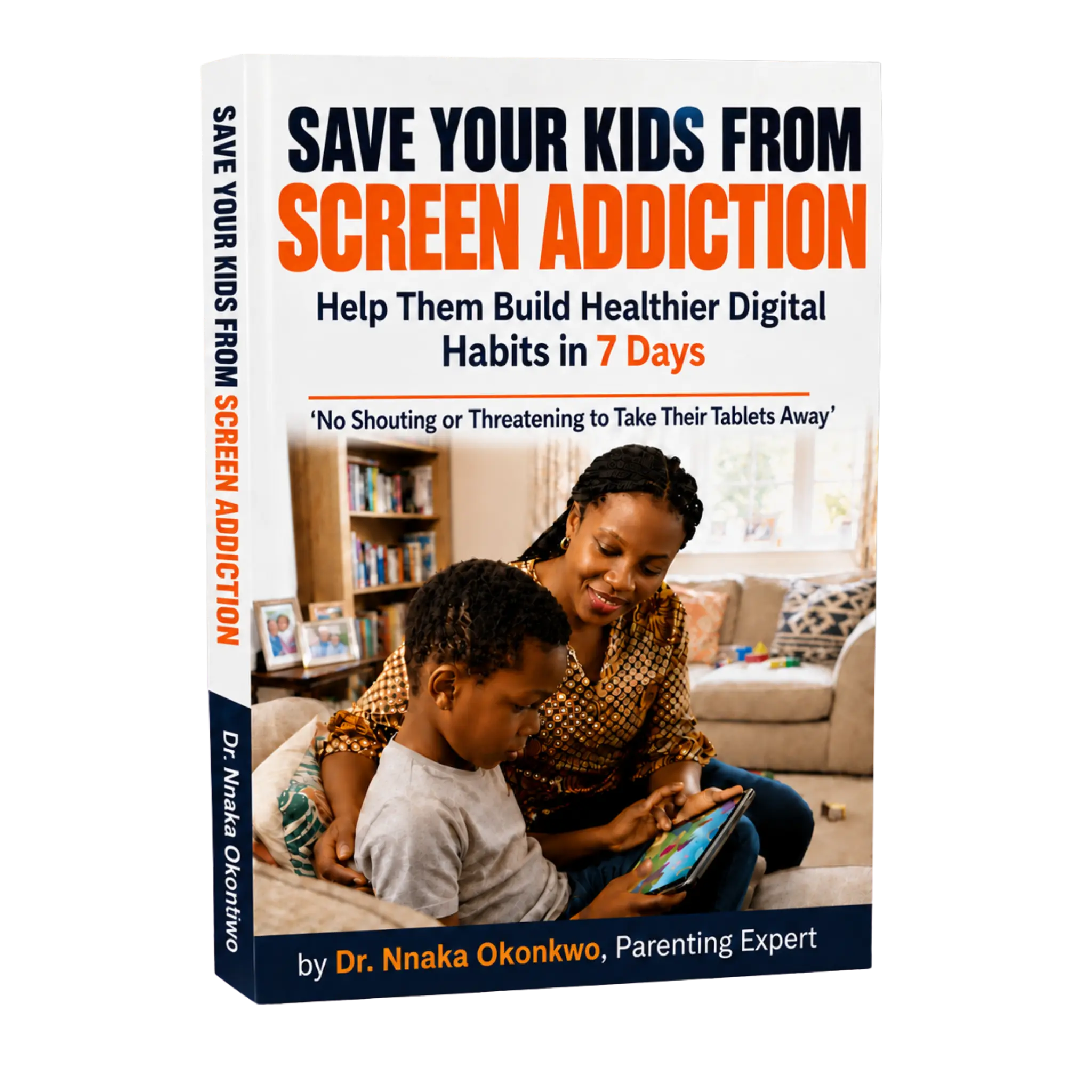
One week of clear actions.
No fluff.
INSIDE THIS GUIDE
This is not a book to read and put away. It is a practical digital PDF guide designed to help parents build clearer boundaries, calmer transitions, protected sleep, and routines the family can keep.
See what your child is reaching for, when the pattern appears, and what the screen may be replacing.
Audit habits, create no more than five family rules, have the calm boundary talk, set predictable windows, handle resistance, build a Family YES List, then review and lock it in.
Turn vague instructions like “less screen time” into clear boundaries that are realistic enough to enforce and stick.
Use calm words for the moments when screen time ends, pushback starts, or an agreement needs to be repaired.
Keep sleep, responsibilities, relationship, movement, and offline life in view with a simple monthly 10-minute reset.
Use the Troubleshooting page, Family Screen Agreement, and 7-Day Reset Tracker to make the plan visible.
IN THE AUTHOR’S WORDS
My son Obinna was 11 when I realised our screen-time problem had moved beyond a few extra videos after school. We had first given him a tablet for learning. Then a phone followed. Work was busy, and screens had gradually become the easy way to keep evenings calm...
That is how it happened in our home: not with one dramatic decision, but with a series of reasonable ones. The tablet was for learning. A video bought me enough quiet to finish something. The phone made it easier to reach him. When the day was full, the screen was the answer that required the least energy from everyone.
At first, it looked manageable. Then little compromises started adding up. The screen became the first thing he reached for and the thing he resisted giving back. It was not simply that he liked videos or games. The device had started to organise the rhythm of our evenings.
One Sunday night, I found him under his blanket at 12:40 a.m., the tablet glowing against his face. When I asked what he was doing, he snapped, “Just five more minutes!” He was not relaxing. He could not stop. That moment stayed with me because I recognised the difference between choosing a few minutes and feeling pulled into more minutes.
The cost showed up in ordinary places first. He slept late and woke exhausted. Homework was missed, and his grades fell. When real-life activities began, he became irritable. He could disappear for hours into videos. Evenings that could have been simple became arguments, and the more we argued, the more the screen seemed to become the centre of our relationship.
I felt guilty, angry, and afraid I was losing my son. I also felt the uncomfortable truth that I had helped create the pattern. The device had been the convenient answer to busy days, and now I was asking him to stop using the answer I had made so available. I did not want to blame him for being drawn to something designed to hold attention. I wanted to understand what our family needed to do differently.
My first response was sudden confiscation. It caused explosive tantrums, and within two days I gave in. Then I tried shouting and threats. He got sneakier. I made vague rules like “less screen time,” which only gave us something else to argue about because neither of us knew exactly what the rule meant. I changed the Wi-Fi password; he switched to his phone.
Each attempt made sense for a moment. If the tablet was the problem, remove it. If he was refusing, raise my voice. If the internet was the route in, close the route. But each approach treated the latest device or argument as the whole problem. There was no clear, predictable system for what happened before screen time, when it ended, or what came next. My enforcement depended on my mood, how busy I was, and how much energy I had left at the end of the day.
Obinna was not learning a routine. He was learning to wait me out. I was not teaching a boundary that he could understand and practise. I was announcing a new limit whenever I reached my own limit.
I combined my training in human behaviour with research on screen time and the developing brain, then tested approaches at home. The key insight was not another punishment. It was involving Obinna in making the rules and making the next step predictable. A boundary would have a better chance of becoming a habit if he could see it, understand it, and know what happened after the screen went off.
We started with a short audit instead of a dramatic ban. We looked at when he used screens, what usually came before the request, and what the screen was replacing. That first step made the pattern easier to discuss because we were looking at what happened rather than arguing about whether he was “good” or “bad.” A pattern was a pattern. It was not a character flaw.
On day one, we audited.
Day two, we created a certain number of family rules—anything more and they’ll forget them.
The calm boundary talk was on day three.
Day four, we set predictable screen windows.
Then came day five, handling resistance without escalating.
On day six, we listed replacement activities.
Finally, we reviewed, adjusted, and locked the routine in on day seven.
The process gave us something to return to when a difficult evening made us doubt ourselves.
It was not a perfect transformation. Some evenings still brought pushback, especially around new games. Consistency from every adult mattered most. It was easy for one person to hold the line while another, tired or distracted, made an exception without explaining it. We had to remember that the goal was not to win every conversation. The goal was to make the family pattern more predictable over time.
But the pattern did change. Within a few weeks, bedtime battles eased. Within a month, homework came before screens and Obinna started choosing other activities. His grades recovered the following term. The biggest change was not that he never wanted a screen. It was that the screen stopped being the only plan, and our evenings stopped revolving around the question of whether he was allowed to have one more minute.
I made this guide because I wished I had one clear, step-by-step plan on day one. Other parents kept asking what I did, and I knew that a useful answer needed to be more than “be stricter.” It needed to show the sequence: notice the pattern, make the rules together, plan for resistance, offer a real alternative, and keep returning to the routine.
That is why the guide begins with a 15-minute audit and a short pattern check. It is why it includes a Family Rule Builder, a Resistance Script Bank, a printable Family Screen Agreement, and a 7-Day Reset Tracker. These are not meant to create a perfect household. They are meant to reduce the number of decisions a tired parent has to improvise at the end of the day.
That is what this guide is: a practical starting point for parents who want fewer daily battles and more connection, without pretending every family will have identical results. It covers the child’s routine, but it also asks parents to look at the behaviour children see from us. The work is shared. The standard is progress, not performance.
REAL PARENTS. REAL WORDS.
**These are customer comments shared with permission. Locations and star ratings are not shown because they were not collected.
“As a busy mom, I needed something to tell me do this and that and that. This was it. Most importantly, my boys now spend much less time on their tabs. One plays football, the other chose Tae Kwon Do.”
“ 1 month after implementing this the plan in this workbook, my kids know the place of their devices - they come after homework and chores are done and no tabs after 845pm.”
“Best $9.95 I ever spent. I am happiest now that my girls and I speak more. They've been joining me to paint in my studio after their homework these days. My 12 year old started writing her own storybook yesterday.”
“My husband saw your webpage and sent me the link. I got the PDF. We agreed to execute together. Our children now spend less time on tabs.”
“Our three children are no longer glued to screens. If you take the time to follow Dr. Nnaka's action plan, like us, you'll thank God you did.”
“I am so happy with how my kids are transformed after I followed the instructions in this workbook. I've paid therapists close to $1000 without any real results.”
“I was able to approach my kids about screen time without the tantrums. They now follow the rules we jointly agreed on.”
“This workbook is straight to the point. My teenagers know that following the rules is a family non-negotiable. They went from resisting to supporting each other.”
NEXT 100 PURCHASES
$19.90 $9.95 USD
The next 100 buyers receive the main guide plus both PDF bonuses. The price returns to $19.90 after the next 100 purchases.
BONUS STACK
Both bonuses are included free for everyone who buys during the NEXT 100 purchases.

Learn how screen habits can affect sleep, mood, attention, and play; notice warning signs; use three calm questions; take a simple first step; and know when it may be time to speak with a pediatrician. Heavy screen time is not automatically addiction.

A parent-focused companion that helps you notice your own phone habits, set one commitment your family can see, and model the screen boundaries you’re asking your children to follow. It includes scripts, a work-boundary plan, and a seven-day parent tracker.
 GET THE GUIDE + BONUSES $9.95
 BEFORE YOU DECIDE
You receive SAVE YOUR KIDS FROM SCREEN ADDICTION ONLY PDF Workbook plus the two PDF bonuses if you're part of the next 100 action takers - otherwise you receive SAVE YOUR KIDS FROM SCREEN ADDICTION ONLY.
The guide is for children and teens (ages 4-17) who use YouTube, gaming, tablets, phones, computers, or TV for recreation. For very young children, use age-appropriate professional guidance; WHO has specific recommendations for children under five.
No. The goal is a home where screens have a place without running the house. The 7-day plan helps you set boundaries your family can repeat.
Results vary by family. The guide can help you create clearer boundaries, calmer transitions, protected sleep, and routines you can keep, but it does not promise identical results or replace professional help.
The next 100 buyers get them for $9.95 USD instead of $19.90. You'll see the equivalent local-currency amount at checkout.
This is a digital PDF download delivered to your device. There is nothing to ship.
No. This guide is educational and is not medical or mental-health advice. If you’re concerned about your child’s health or behaviour, please consult a qualified professional.
THE NEXT CONVERSATION CAN BE DIFFERENT
You care about who your child is becoming. Give yourself a clear, practical starting point for the screen-time conversations you’ve been dreading—one that is predictable, not perfect.
SAVE YOUR KID FROM SCREEN ADDICTION NOW$19.90 $9.95 USD · Next 100 purchases · Secure checkout